AI and robotics courses are no longer optional learning. The job market your child will enter in 2035 does not exist yet. Roles like prompt engineer, drone fleet manager, and surgical robotics technician barely existed a decade ago. This shift is why AI and robotics courses are core preparation for tomorrow’s workforce.
Indian companies hired over 45,000 robotics and AI professionals in 2025 alone. Schools are racing to add these subjects, but classroom theory is not enough. Children need hands-on building, real coding practice, and exposure to working systems. This blog explains exactly how the best AI and robotics courses shape students for careers that pay well and matter.
Table of Contents
- Why Future Careers Demand AI and Robotics Skills
- What Students Actually Learn in AI and Robotics Courses
- 6 Career Paths These Courses Open Up
- How Technobotics Designs AI and Robotics Courses
- Soft Skills That Matter as Much as Technical Skills
- How Parents Can Support This Journey
- FAQs
Why Future Careers Demand AI and Robotics Skills
Automation is no longer limited to factory floors. Hospitals use surgical robots. Banks run AI fraud detection. Farms deploy autonomous tractors. Every industry now needs people who understand how smart machines think and move.
The World Economic Forum predicts 170 million new tech-driven jobs by 2030. Most will require some level of programming, sensor handling, or AI literacy. Students who start early gain a measurable advantage in college admissions and entry-level hiring.
A child who builds robots at age 12 thinks differently at 22. They debug problems faster. They handle ambiguity better. These habits matter more than any single technical skill.
What Students Actually Learn in AI and Robotics Courses
A well-designed course teaches three layers simultaneously.
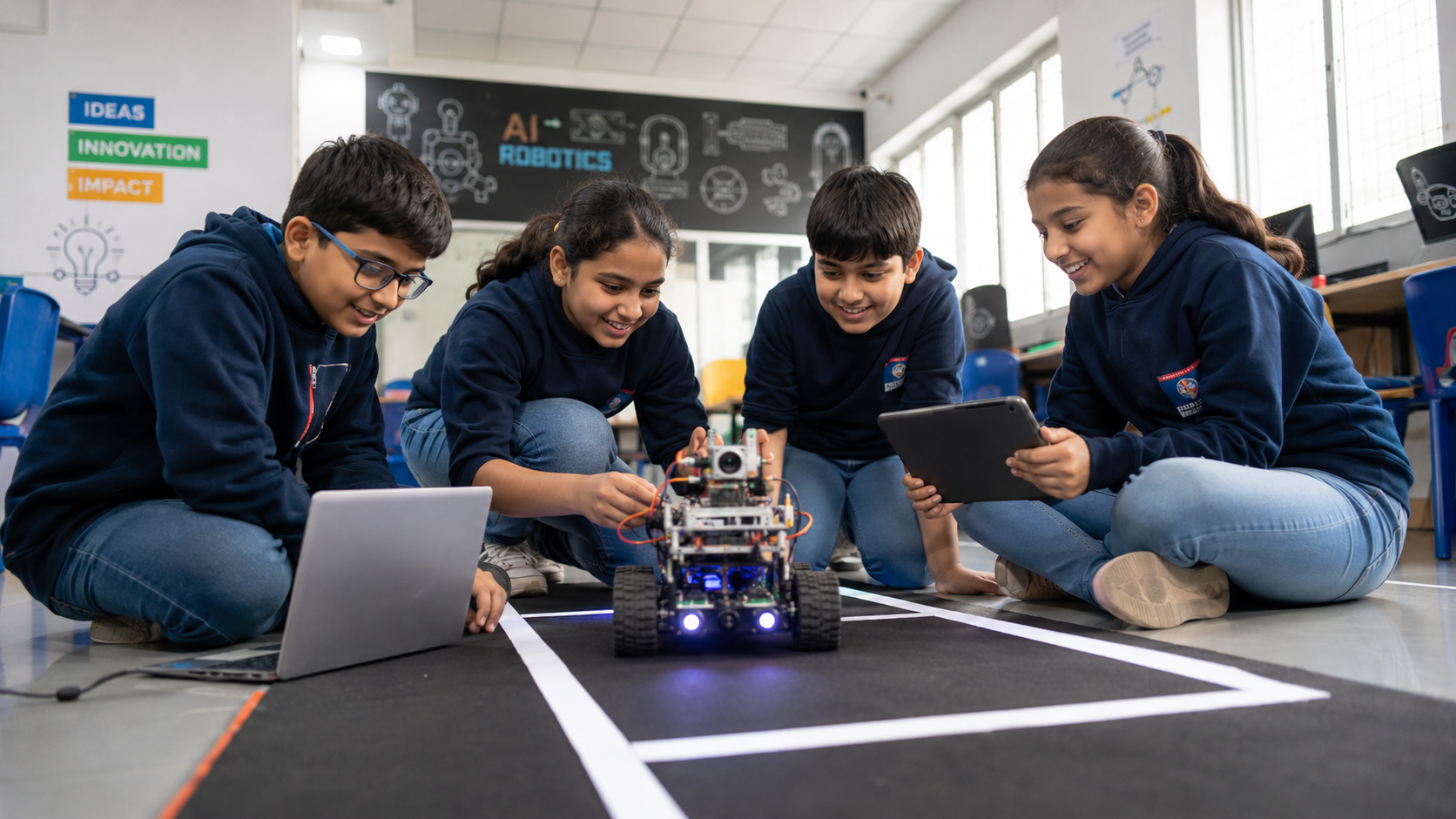
Hardware skills cover sensors, motors, microcontrollers, and circuit design. Students learn to wire components, troubleshoot connections, and build working machines from scratch.
Programming skills start with block-based logic and move to text-based languages like C++ and Python. Students write code that reads sensor data, makes decisions, and controls movement.
AI integration introduces machine learning concepts through practical projects. Students train models to recognise faces, classify objects, or follow voice commands.
The combination matters. A student who only codes cannot build. A student who only builds cannot scale ideas. AI and robotics courses bridge both worlds through a single, structured pathway.
6 Career Paths These Courses Open Up
1. Robotics Engineer
Designs and builds machines for manufacturing, healthcare, and defence. The average starting salary for a robotics engineer in India is between 6 and 12 lakh rupees annually for entry-level roles.
2. AI and Machine Learning Specialist
Trains models for chatbots, recommendation systems, and autonomous vehicles. This is among the highest-paying tech roles in India today.
3. Automation Engineer
Works with companies to replace manual processes with smart systems. Demand is strongest in Mumbai, Pune, and Bangalore.
4. Drone Pilot and Designer
DGCA-certified drone work covers agriculture mapping, delivery, surveillance, and cinematography. India’s drone sector is forecast to reach 4 billion dollars by 2030.
5. IoT Solution Architect
Builds connected device systems for smart homes, smart cities, and industry. Combines hardware, cloud, and AI in one role.
6. Tech Entrepreneur
Many robotics startup founders began as hobbyists at the school level. Early exposure builds the maker mindset that defines successful founders.
How Long Does It Take to See Results?
Parents often ask how quickly children show progress in AI and robotics courses. The answer depends on consistency, not talent.
In the first 3 months, most students build their first working robot and understand basic circuit logic. By month 6, they begin writing simple Arduino code and modifying existing projects. By the end of year one, students typically complete 4 to 6 independent projects and can troubleshoot common hardware issues without instructor help.
Year two introduces AI integration, sensor fusion, and advanced programming. Most Technobotics students enter robotics competitions by year three. The journey is structured, measurable, and visible. Parents see the change in confidence, focus, and problem-solving long before any career outcome.
How Technobotics Designs AI and Robotics Courses
Most institutes teach robotics as a one-size programme. Our approach is different. We layer skills based on age and prior exposure, which is what makes our AI and robotics courses stand out in Mumbai.
Younger students start with Autonomous Robotics without Programming, where they learn sensor logic through hands-on builds. No coding is required at this stage.
Once a child is comfortable with mechanical and logical thinking, they move to Arduino Programming. Here, they write real code, control motors, and read live sensor data.
Advanced learners enter Autonomous Robotics with Programming, which covers Bluetooth, wireless control, voice modules, and AI sensor integration. This is where students start building portfolio-grade projects.
Each level connects to the next. Skills compound instead of resetting.
Soft Skills That Matter as Much as Technical Skills
The best AI and robotics courses develop more than just coding ability. Recruiters in tech hire for problem-solving, not just degrees. Robotics naturally develops these qualities.
Students learn to break large problems into small steps. They practise patience when code fails on the tenth attempt. They communicate ideas to teammates who think differently. They present projects to judges and audiences.
These habits transfer to every career, even outside engineering. A student who debugs a robot at 14 handles workplace ambiguity at 24.
How Parents Can Support This Journey
Choose a course that includes real building, not just theory. Ask the institute how many hands-on hours your child gets each week. Look for instructors who have industry experience, not just teaching backgrounds.
Encourage projects at home. A simple breadboard kit costs less than a video game. Avoid pushing competitions too early. Internal motivation lasts longer than trophies.
Talk to your child about real-world applications. Show them news about Indian robotics startups. Visit science centres. Watch documentaries on automation together. For deeper context, read our guide on why every school needs a robotics curriculum.
Conclusion
The future will reward students who can build, code, and adapt. AI and robotics courses give children all three capabilities, plus the soft skills that carry across careers. The earlier the start, the deeper the advantage.
Technobotics has spent 15 years preparing students from Mumbai schools for futures like these. Our structured course pathways move from hands-on basics to advanced AI integration, in a sequence that aligns with how children actually learn. Whether your child wants to design drones, train AI models, or launch a startup, the foundation begins with the right course choice today.
Frequently Asked Questions
1. At what age should my child start AI and robotics courses? Children as young as 7 can begin with basic robotics that uses sensors and logic without coding. AI concepts typically suit students aged 11 and above, once they understand basic programming. Starting earlier gives more time for skills to mature naturally before college applications.
2. Do AI and robotics courses require strong maths skills? Basic arithmetic is enough to start. Logical thinking matters more than advanced maths in the early stages. As students progress to machine learning topics, geometry, algebra, and statistics become useful. Most institutes integrate these concepts gradually, so students rarely feel overwhelmed.
3. What is the difference between AI courses and robotics courses? AI courses focus on software intelligence, teaching machines to learn, recognise patterns, and make decisions. Robotics courses focus on physical machines that sense and move. Modern AI and robotics courses combine both, since most real-world applications require machines that think and act.
4. Can robotics learning help with school academics? Yes. Students who study robotics often improve in physics, mathematics, and computer science. The hands-on application makes abstract concepts concrete. Many students also report better focus, problem-solving habits, and confidence during school presentations and project work.
5. Are AI and robotics careers in demand in India? Demand is rising sharply. India added over 45,000 robotics and AI roles in 2025. Sectors like manufacturing, healthcare, agriculture, and defence are hiring the fastest. Salaries for skilled professionals often exceed traditional engineering pay scales by 30 to 50 per cent.