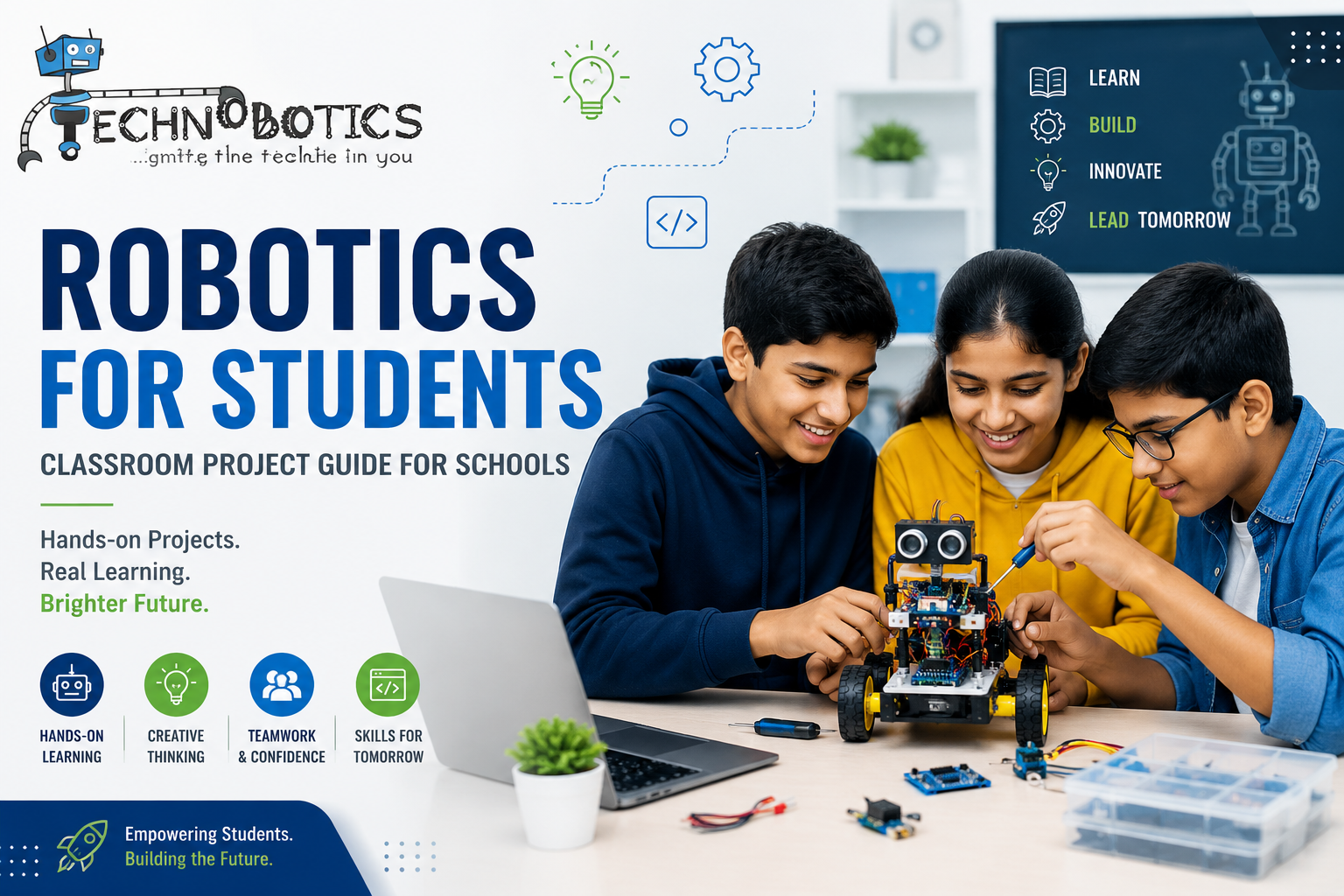
Robotics for students is one of the most practical ways to make science, technology, engineering, and mathematics easier to understand. Instead of just reading textbook concepts, students can build models, test ideas, solve problems, and see how technology works in real-world situations.
For schools, the goal need not be complicated. A good start is to introduce simple classroom activities, guide students step by step, and slowly move them toward advanced projects. This approach makes learning more active, exciting, and useful.
Why Robotics for Students Works Best Through Projects
Classroom-based projects make learning more meaningful by connecting theory with action. When students build a small working model, they understand science, mathematics, electronics, coding, and logic in a practical way.
For example, a simple robot car can teach motion, direction, energy, circuits, and programming logic. A sensor-based project can help students understand how machines detect light, distance, movement, or obstacles.
This kind of learning keeps students active. They are not only listening to a lesson. They are planning, building, testing, and improving their own work.
How Schools Can Start Classroom Projects Step by Step
Schools can begin with a simple plan. The first step is to decide the learning goal. The second step is to select age-appropriate projects. The third step is to provide the right kits, teacher guidance, and classroom structure.
A project should always match the students’ age and level of understanding. Younger students can begin with simple moving models, LED activities, basic circuits, or mechanical structures. Middle school students can work on sensors, motors, switches, and beginner coding logic. Older students can explore Arduino, automation, IoT, app-based control, and problem-solving models.
This is why robotics for students works well in schools that want to make learning more practical and activity-based.
The key is to move from simple to advanced instead of starting with difficult projects immediately.
Step 1: Decide the Learning Objective
Before choosing a project, schools should ask what students are expected to learn. The project should not be added only as a fun activity. It should support classroom learning.
For example, if the objective is to teach electricity, students can create a basic circuit using LEDs and switches. If the goal is to explain motion, they can build a simple wheeled robot. If the objective is to introduce automation, they can work with sensors and microcontrollers.
This helps teachers keep the activity focused and useful.
Step 2: Select Age-Wise Project Levels
Not every project is suitable for every grade. Schools with robotics programs should divide projects into levels so students can learn without feeling confused.
Primary students can begin with simple structure-building, battery-powered models, basic circuits, and cause-and-effect activities. These projects help them understand how parts connect and how energy creates movement.
Middle school students can try obstacle-avoiding robots, traffic signal models, line-following robots, and basic sensor activities. These projects help them understand inputs, outputs, and simple logic.
Senior students can work on Arduino-based robots, Bluetooth-controlled systems, smart home automation, IoT models, and app-connected projects. These activities prepare them for more advanced technology learning.
A level-wise approach makes robotics for students easier to understand and more enjoyable in every grade.
Step 3: Use Simple Kits Before Advanced Tools
A school does not need a large lab to begin. A basic kit can help students understand the foundation clearly.
A beginner kit can include breadboards, jumper wires, LEDs, resistors, switches, motors, wheels, sensors, batteries, and a basic microcontroller. These components are enough to create many classroom projects.
This is where technology in education becomes more practical. Students are not only using screens or smartboards. They are building working systems and understanding how each part contributes to the result.
Step 4: Train Teachers for Smooth Execution
Teacher training is important for successful project-based learning. Teachers do not need to become advanced engineers, but they should understand the project flow.
Teacher support is important because robotics for students becomes more effective when classroom guidance is clear and structured.
They should know how to explain the activity, manage materials, guide students, identify common errors, and encourage students to troubleshoot. This helps the classroom stay organised and reduces confusion.
A short teacher orientation, demo session, or hands-on workshop can make a big difference. When teachers are confident, students also feel more confident.
Step 5: Divide Students into Small Teams
Robotics projects work best when students collaborate. A small team of three to five students is ideal for classroom learning.
One student can handle components. Another can connect the circuit. One can observe the output. One can write or adjust the logic. Another can present the project.
This method makes robotics for students more practical because they learn by solving real problems instead of only following instructions.
Good STEM education courses should support teamwork along with technical learning. Students learn how to share ideas, listen to others, divide responsibilities, and solve problems together.
Step 6: Follow the Build, Test, and Improve Method
Students should understand that a project may not work perfectly on the first attempt. That is normal.
The best method is simple: build the project, test the result, observe the problem, and improve the design. If a motor does not move, students can check the battery, the wire connection, the switch, or the code. If a sensor does not respond, they can check its position and connection.
This process teaches patience and logical thinking. It also helps students see failure as part of learning, not as something to avoid.
Step 7: Connect Projects with Regular Subjects
Classroom projects should connect with regular school subjects. This makes the learning more useful.
In science, students can understand electricity, force, energy, motion, light, and sensors. In mathematics, they can apply concepts such as measurement, angles, speed, distance, and patterns. In computer studies, they can learn logic, sequencing, loops, and automation.
This is how educational technology in schools becomes more valuable. It supports the subjects students already study and makes them easier to understand.
Step 8: Start with Guided Activities
In the beginning, students need clear instructions. Teachers can give them a fixed project with defined steps.
Guided activities help schools introduce robotics for students without making the subject feel difficult in the beginning.
For example, students can first build a basic moving robot. Once they understand how it works, the teacher can ask them to modify it. They can add a sensor, change the movement pattern, or improve the design.
This method gives students confidence. It also allows teachers to control the pace of learning.
Step 9: Move Toward Creative Challenges
After students complete guided projects, schools can introduce open-ended challenges.
For example, students can be asked to design a robot that avoids obstacles, follows a line, turns on a light automatically, or solves a classroom problem. They can also create simple models related to traffic systems, home automation, water saving, or safety.
These challenges encourage creativity. Students begin thinking like problem-solvers rather than just following instructions.
Step 10: Assess the Complete Learning Process
Robotics projects should not be judged only by the final result. A robot that works perfectly is good, but the learning process matters more.
Schools can assess students on teamwork, effort, creativity, understanding of components, ability to explain the project, troubleshooting, and improvement. This gives every student a chance to show their strengths.
Some students may be better at building. Some may be better at coding. Some may explain concepts clearly. Some may quickly identify errors. A good project allows all these skills to come to the fore.
Step 11: Organise Project Showcases
A project showcase can motivate students and create excitement in the school. Schools can host a STEM day, a robotics exhibition, an inter-class challenge, or a parent demo session.
When students present their projects, they build confidence and communication skills. Parents also get to see how practical learning supports academic growth.
This is a strong example of how technology is impacting education, as students are not just learning from books. They are creating, testing, explaining, and improving real projects.
How Technobotics Supports Schools
Technobotics helps schools introduce practical learning through robotics, STEM activities, electronics, coding, Arduino programming, app development, and classroom-based projects.
The focus is on helping students learn by doing. Instead of only explaining technology, Technobotics guides students to build working models and understand how real systems function.
With structured modules, hands-on activities, teacher support, and age-wise learning paths, schools can introduce robotics for students in a simple and effective way.
FAQs
1. Why should schools introduce robotics projects for students?
Schools should introduce robotics projects because they make learning practical, active, and skill-based. Students learn problem-solving, teamwork, logical thinking, creativity, and technical basics while connecting classroom subjects with real-world applications.
2. Are robotics projects useful for students who are not interested in engineering?
Yes, robotics projects are useful even for students who do not plan to become engineers. They build thinking skills, patience, creativity, communication, and confidence, which are valuable in many fields beyond technology.
3. How often should schools conduct robotics sessions?
Schools can begin with weekly or bi-weekly sessions. Regular sessions help students build continuity and confidence. Schools can increase the frequency during exhibitions, competitions, workshops, or special STEM activity weeks.
4. What kind of projects are suitable for beginners?
Beginner-friendly projects include LED circuits, simple moving robots, traffic light models, obstacle-avoiding robots, sensor-based alarms, and basic automation models. These projects are easy to understand and help students build a strong foundation.
5. How can schools measure student progress in robotics?
Schools can assess students through teamwork, project completion, creativity, troubleshooting ability, explanation skills, and improvement after testing. The focus should be on the learning process, not only on whether the final model works perfectly.