India’s educational robotics market reached $38.3 million in 2024 and is projected to hit $189 million by 2030 (Grand View Research, 2024). That growth signals one thing clearly: robotics skills are moving from hobby to curriculum standard. But not every kit available in India delivers the same learning outcome. The wrong purchase wastes money and kills curiosity before it has a chance to grow. This guide breaks down the best robotics kits for kids in India 2026, age group by age group, with real prices and honest guidance. If you’re also evaluating /robotics-and-stem-for-young-minds/, this guide pairs well with structured coaching.
Key Takeaways
- India’s educational robotics market is projected to grow from $38.3M (2024) to $189M by 2030 (Grand View Research)
- mBot Neo (INR 6,500-8,000) suits ages 8-10, supports both block coding and Python on identical hardware, and stays relevant as your child’s skills grow over several years
- LEGO Education SPIKE Prime (INR 25,000-35,000) is the WRO official kit for Elementary and Junior categories
- ACEBOTT ESP32 (INR 8,049) and Arduino TinyML board (INR 5,599) open IoT and machine learning paths at age 12+
- Under INR 2,000 kits consistently disappoint. Skip them.
Table of Contents
- Why Does Choosing the Right Robotics Kit Matter for Indian Parents?
- Ages 6-8: What Should a Starter Robotics Kit Include?
- Ages 8-10: Is mBot Neo the Right Kit for a Child Starting Robotics?
- #spike-prime
- Ages 12 and Above: Which Kits Move Beyond Toy Robotics?
- #comparison
- Why Should You Avoid Kits Below INR 2,000?
- #faqs
Why Does Choosing the Right Robotics Kit Matter for Indian Parents?
The Kids Interactive Robot market globally is projected to reach $4.2 billion by 2033 (MarketsandMarkets, 2024). NASSCOM data confirms India needs over 1 million additional technology-skilled workers annually. Robotics and coding skills are moving toward core curriculum, not optional extras.
The kit your child starts with shapes which skills they build over the next five years. A child who learns on well-supported hardware develops real confidence. One stuck on a poorly documented kit develops frustration instead. Choosing the right kit, matched to your child’s current age and skill level, is the single most important buying decision in this space.
Ages 6-8: What Should a Starter Robotics Kit Include?
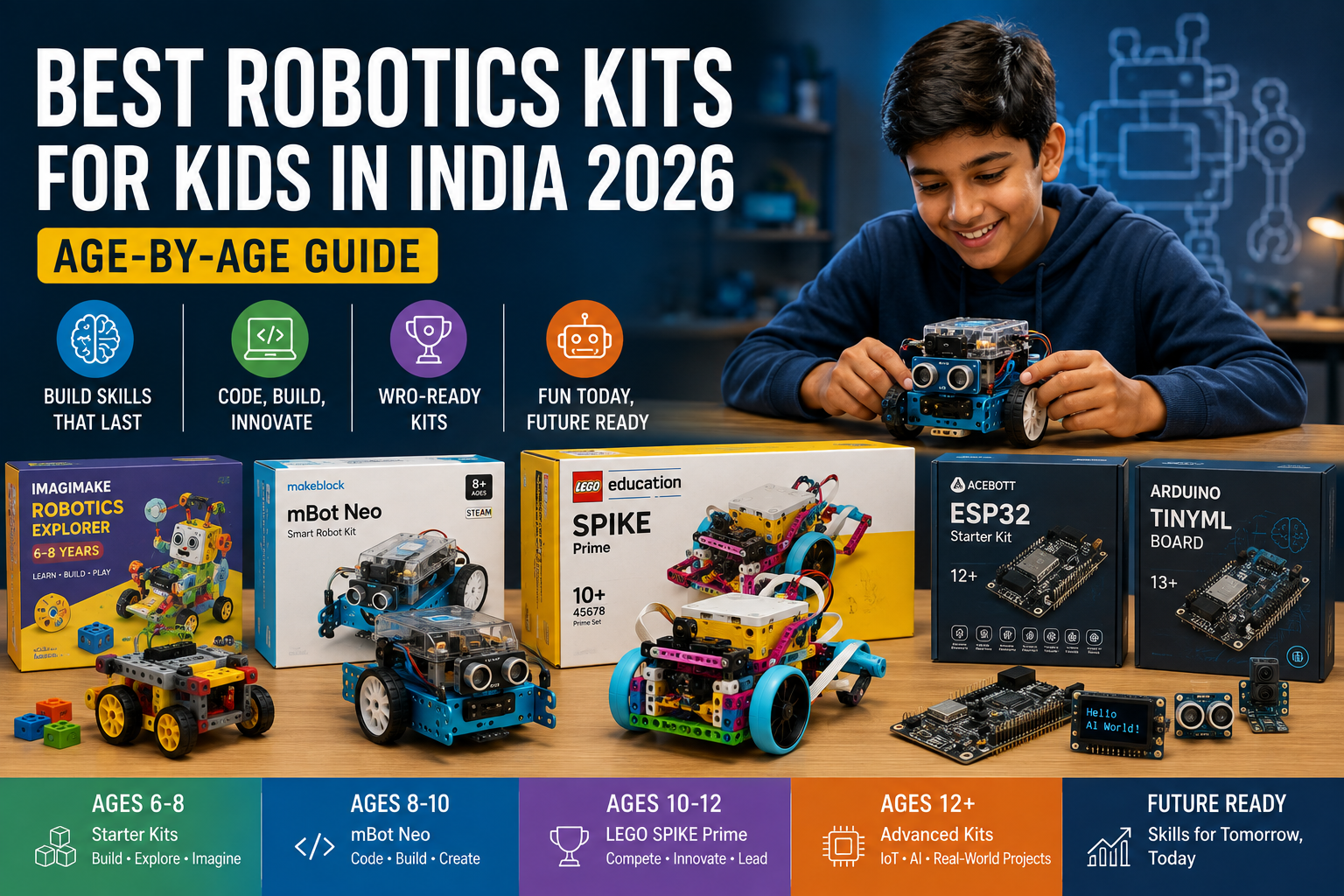
No single commercial kit dominates the 6-8 age range in India the way LEGO SPIKE Prime dominates age 10+. Children at this stage learn best through physical manipulation, not screen interfaces. The right starter kit has snap-fit parts with no soldering, clear illustrated instructions a child can follow independently, and no proprietary app that requires an account or paid subscription.
Brands like Imagimake, Smartivity, and Quirkle offer India-specific options priced between INR 1,500 and 3,500 with activity booklets in English and Hindi. Focus on kits that build spatial reasoning and fine motor control at this stage. Both skills become the foundation for block coding at age 8. A kit without structured activity guidance is simply a bag of parts for a 6-year-old, and a bag of parts does not teach robotics.
The 6-8 age range has fewer standout options than older age groups, but the evaluation criteria are clear. Ask three questions before buying: Does the kit come with step-by-step illustrated instructions, not just a parts list? Are replacement components available if something breaks? Does the brand have a support email or community group? A “yes” on all three is the minimum standard. Most kits under INR 1,000 fail at least two of these checks immediately.
Ages 8-10: Is mBot Neo the Right Kit for a Child Starting Robotics?
The mBot Neo by Makeblock costs between INR 6,500 and 8,000 in India and stands as one of the strongest entry-level robotics kits for ages 8 and above. It is WiFi-enabled, meaning children program and control it wirelessly from a tablet or laptop. More importantly, it supports both block coding via mBlock software (Scratch-compatible) and Python on the same hardware. Your child does not outgrow the kit as their skills develop.
Assembly takes around 30 minutes. The Scratch-based interface removes the barrier to a first project for any child who has never written code. If your child targets WRO from age 10, use mBot Neo as the foundation and transition to SPIKE Prime then.
mBot Neo is also directly relevant to the /cbse-ai-coding-curriculum-2026-classes-3-8/ for Classes 3 to 8. Children using it at home alongside school lessons arrive at block coding and early Python assessments with practical experience, not just theory. The kit’s documentation is comprehensive, and the mBlock community across India is active, which means your child is rarely stuck without a solution path.
Ages 10-12: LEGO Education SPIKE Prime Is the WRO Standard
LEGO Education SPIKE Prime costs between INR 25,000 and 35,000 in India and is the official kit for WRO Elementary and Junior categories, confirmed by the World Robot Olympiad Association. If your child is interested in competitive robotics, this is not a recommendation. It is the requirement. Using any other kit for WRO Elementary or Junior preparation wastes both money and preparation time.
SPIKE Prime supports both Python and Scratch-based block coding, making it accessible for children moving up from mBot Neo. Schools affiliated with WRO India typically supply these kits as part of the program, reducing individual family costs.
WRO 2026 Kit Note
LEGO Education SPIKE Prime is confirmed for WRO Elementary and Junior categories in 2026. LEGO Mindstorms EV3 is still accepted at the Senior level but is being phased out. Check wro-association.org for current eligibility rules before purchasing any competition kit, as specifications update each year.
LEGO Mindstorms EV3 remains widely used among Senior category competitors and is a solid kit for families who already own one. For a new purchase in 2026, SPIKE Prime is the correct long-term investment. Explore /robotics-classes-kids-mumbai-wro-2026/ if your child is targeting this season.
Ages 12 and Above: Which Kits Move Beyond Toy Robotics?
At age 12, the gap between a robotics toy and a real electronics project becomes worth crossing. Both kits in this section use genuine microcontrollers and professional programming environments. The skills they build transfer directly into CBSE and CISCE computer science coursework at Class 9-10 and into competitive STEM applications at the state and national level.
ACEBOTT ESP32 Starter Kit: INR 8,049, Age 12 and Above
The ACEBOTT ESP32 kit includes an ESP32 microcontroller with built-in WiFi and Bluetooth, 30+ components, a 260-page manual, and a structured 33-project curriculum. Programming runs in the Arduino IDE, which transfers directly to CBSE and CISCE computer science modules at the Class 9-10 level. Typical projects include temperature monitors, motion-triggered alerts, and basic smart home automation.
This is the first “serious” hardware step after block coding. Children who complete the ACEBOTT curriculum understand how sensors communicate with microcontrollers and how code controls physical outputs. That conceptual shift does not happen with toy kits. For school project ideas that work directly with this hardware, see our guide on Arduino projects for school kids.
Arduino TinyML Board: INR 5,599, Age 13 and Above
The Arduino TinyML Kit introduces machine learning at the hardware level, running trained models on a microcontroller without cloud dependency. Projects include gesture recognition, keyword spotting, and basic image classification using Edge Impulse, a browser-based ML training platform.
This kit is not for beginners. It works best after a child completes at least one Arduino or ESP32 project. A 14-year-old with a finished TinyML project holds portfolio work that stands out in school science fairs and STEM program applications.
Best Robotics Kits for Kids in India 2026: Side-by-Side Comparison
Use this table to match your child’s age to the right kit. Price, skills built, and WRO eligibility in one place. The “WRO Ready” column indicates whether the kit is accepted in official World Robot Olympiad categories. “Open Category” means the kit can compete but is not the standard hardware for a specific category. Age ranges are recommendations, not hard limits.
| Starter kits (Imagimake, Smartivity) | 6-8 | 1,500-3,500 | Spatial reasoning, snap-building | No |
| mBot Neo | 8-10 | 6,500-8,000 | Block coding, Python, WiFi robotics | Open Category |
| LEGO Education SPIKE Prime | 10-12+ | 25,000-35,000 | Competition coding, WRO missions, Python | Yes – Elementary and Junior |
| LEGO Mindstorms EV3 | 12-16 | Varies (secondary market) | Robotics, WRO Senior missions | Yes – Senior (phasing out) |
| ACEBOTT ESP32 Kit | 12-14 | 8,049 | Arduino IDE, IoT, electronics | Open Category |
| Arduino TinyML Board | 13-16 | 5,599 | Machine learning, Edge Impulse, sensors | Open Category |
Why Should You Avoid Robotics Kits Below INR 2,000?
India’s online marketplaces carry dozens of “STEM robotics kits” priced between INR 500 and 1,999. Most share the same three problems: poor documentation written in poorly translated English, components that fail within weeks of moderate use, and zero manufacturer or community support when something goes wrong.
A child who gets stuck on step three with no help available does not think “this kit is bad.” They think “robotics is not for me.” That conclusion is harder to reverse than a refund. The INR 3,000 to 5,000 step up to a supported kit, like mBot Neo or the Arduino TinyML board, is the single most important budget decision in this guide. The learning outcomes are not comparable.
The hidden cost in cheap kits is that they tend to break at the component level, not the full-kit level. A single faulty sensor on an INR 999 kit cannot be replaced because no spare parts exist for that product. A child who has spent three weeks on a project and cannot complete it because of a broken component doesn’t return to robotics easily. Spend more once. Do not spend less twice.
Frequently Asked Questions
What age should my child start using a robotics kit?
Most children can start with supervised, snap-assembly kits from age 6. Meaningful independent building typically begins around age 8, when children can follow multi-step instructions and understand basic logic. Starting at 6-7 with simpler kits builds spatial reasoning that pays off when they reach block coding and Python at age 8 to 10. Earlier exposure helps; earlier pressure does not.
Which robotics kit is officially used in WRO competitions?
SPIKE Prime is the WRO standard for Elementary and Junior categories. LEGO Mindstorms EV3 remains valid at the Senior level for now, though WRO is progressively phasing it out of competition rules. Check wro-association.org before purchasing. Kit eligibility changes every year.
Is mBot Neo good for a child who has never coded before?
Yes. mBot Neo is one of the strongest starter options for ages 8 to 10 in India. It uses Scratch-based block coding, so children with zero prior experience pick it up quickly. When the child is ready for Python, the same physical kit supports it without replacement hardware, removing the cost barrier most parents worry about at upgrade time. It is well-documented and widely available across India.
What is the difference between LEGO SPIKE Prime and LEGO Mindstorms EV3?
SPIKE Prime is LEGO Education’s current competition-grade system, officially supported by WRO for Elementary and Junior categories in 2026. EV3 is an older platform accepted at Senior level but is gradually being retired from WRO rules. For any new purchase today, SPIKE Prime is the right long-term investment. Families who already own EV3 can continue using it at the Senior level for now.
Why should I avoid robotics kits priced below INR 2,000?
Budget kits under INR 2,000 typically lack proper documentation, replacement spare parts, and active community support. When a sensor fails, or a project step is unclear, there is no reliable help path. The child’s frustration ends the project. A well-supported kit at INR 5,000 to 8,000 delivers far better learning outcomes and holds up across multiple years of use.
Can a 13-year-old do machine learning projects with the Arduino TinyML board?
Yes, but you’ll need some Arduino or block-coding experience first. The TinyML board at INR 5,599 runs Edge Impulse and supports gesture recognition, keyword spotting, and basic image classification. This is not a beginner kit. It works best after at least one completed Arduino project, and the learning curve is real. But a 14-year-old with a finished TinyML project has genuine portfolio work.
The best robotics kits for kids in India 2026 are those matched to your child’s current age and skill level, not where you hope they’ll be in two years. A child who builds with mBot Neo at age 9 and transitions to SPIKE Prime at age 11 arrives at 14 with genuine, demonstrable skills. Match the hardware to where your child actually is, build consistently, and the progression takes care of itself if you want that guided with experienced instructors and competition-grade equipment, /robotics-classes-kids-mumbai-wro-2026/Use proper hardware from day one.
Technobotics Curriculum Team
The Technobotics Curriculum Team has trained over 10,000 students across 13+ partner schools in Mumbai over 15 years. The team designs age-progressive robotics programs from foundational building through WRO competition preparation, using kits including mBot Neo, LEGO SPIKE Prime, and Arduino platforms. Learn more at Technobotics Robotics Centre Mumbai or contact us with questions.