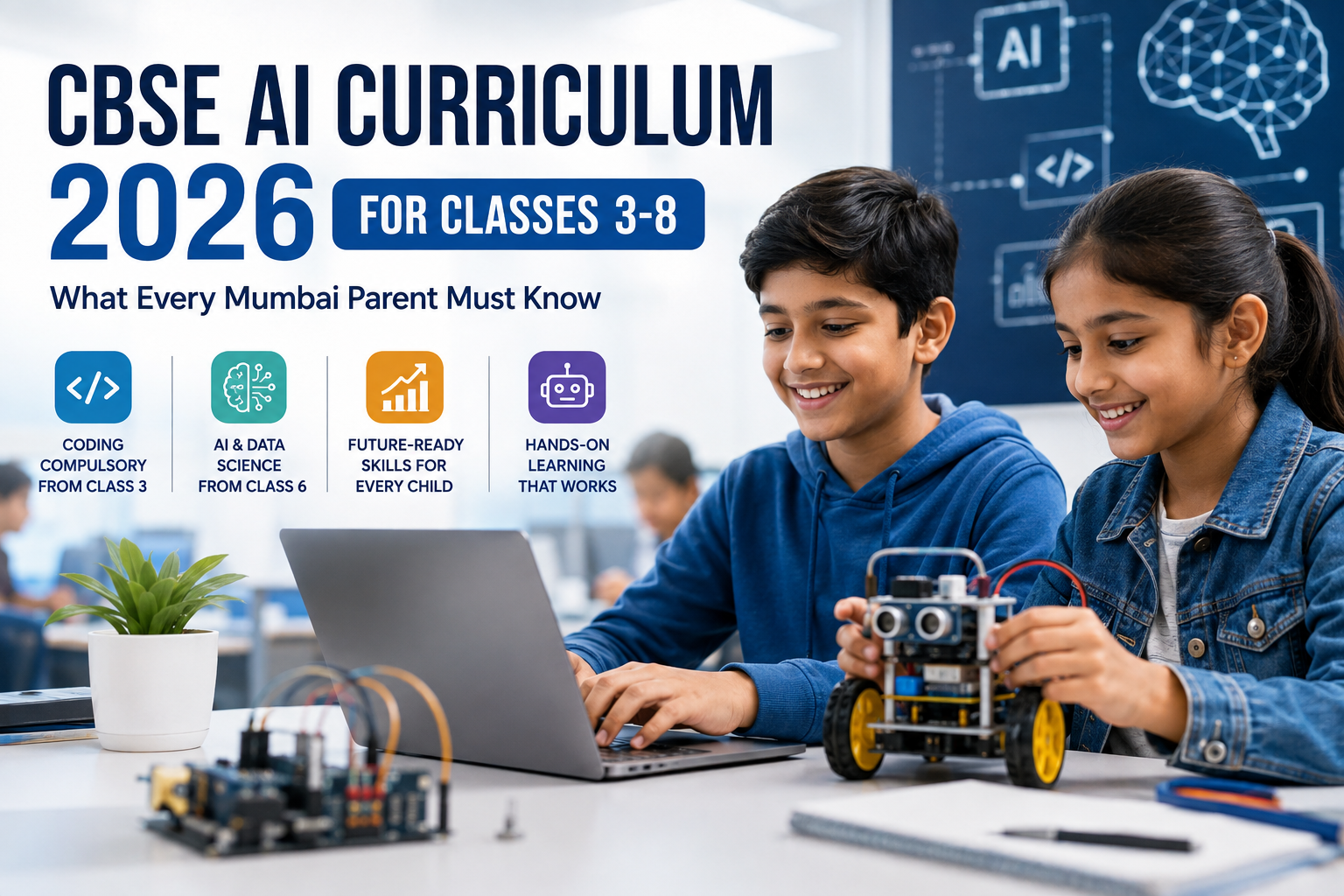
From April 2026, the CBSE AI curriculum 2026 makes AI and coding compulsory for every student from Class 3 to Class 8. Administered by CBSE, this is not an elective. It is not a pilot programme. It applies to millions of students across thousands of affiliated schools nationwide. For Mumbai parents on the CBSE board, this change has immediate consequences, both for how your child is being taught right now and for how prepared they actually are. Understanding what the mandate covers, where schools are falling short, and what you can do about the gap is the first step.
Key Takeaways
- Compulsory from April 2026. Assessed. Not an elective.
- Millions of students across India are affected, but school delivery of the CBSE AI curriculum 2026 is uneven, and many schools have the mandate on paper without the trained teachers or hardware to back it up.
- NEP 2020 mandated coding from Class 6; the CBSE 2026 update extends and formalises that across more grades
- India’s educational robotics market is growing at 32% CAGR, projected to reach $189M by 2030 (ResearchAndMarkets, 2024)
- External STEM programs fill the gap.
Table of Contents
- What Does the 2026 CBSE Mandate Actually Require from Schools?
- Why Does This Mandate Go Further Than NEP 2020?
- CBSE School Readiness in Mumbai: The Implementation Gap
- What Does the CBSE Coding Curriculum Look Like by Class?
- Steps Parents Can Take to Keep Their Child on Track
- Frequently Asked Questions About the CBSE AI Curriculum 2026
What Does the 2026 CBSE Mandate Actually Require from Schools?
The CBSE AI curriculum 2026 makes artificial intelligence and coding compulsory subjects for all students from Class 3 to Class 8, effective April 2026. This is a mandatory curriculum component, not an optional school-level choice. The mandate covers millions of students across India and applies uniformly to all CBSE-affiliated schools. This is the most significant update to primary and middle school subject requirements in recent years.
The change is real, documented, and already in effect. Schools cannot opt out. Students cannot avoid it.
Which Subjects Are Now Compulsory?
The CBSE AI curriculum 2026 covers two areas: coding and computational thinking for Classes 3 to 5, and AI plus data science concepts alongside coding for Classes 6 to 8. Both are graded, examined components. Students are assessed on them, not simply introduced to them. Each grade level has a defined syllabus that schools are expected to follow.
What Will Students Actually Study?
The CBSE coding curriculum covers a structured progression across the grade range. Students can expect:
- Classes 3-5: block-based visual programming, logical sequencing, and problem-solving using tools like Scratch
- Classes 6-7: introductory Python, basic algorithm thinking, and early AI concepts, including how machines process data
- Class 8: applied AI projects, data handling, and structured programming tasks, similar in scope to Arduino and coding projects for school kids
Why Does This Mandate Go Further Than NEP 2020?
NEP 2020 established coding and computational thinking as a policy mandate from Class 6, but left the specifics to individual boards. The CBSE AI curriculum 2026 goes significantly further: it formalises the subject from Class 3, structures it across six grade levels, and makes it an assessed component rather than a vague recommendation. India’s educational robotics market reflects the scale of this shift. Valued at $38.3 million in 2024 and projected to reach $189 million by 2030 at a 32% CAGR (ResearchAndMarkets, 2024), that growth is the market responding to a structural change in how India teaches technology at the school level.
The NEP 2020 Connection Explained
NEP 2020 set the policy intent. CBSE’s 2026 directive converts that intent into curriculum accountability. Schools can no longer treat coding as a co-curricular add-on or a computer lab period with no defined outcomes. It is now a core subject with syllabi, learning objectives, and assessments. The shift from policy to curriculum changes what schools must deliver and what questions parents should be asking.
Scale of the Mandate
CBSE covers over 26,000 affiliated schools across India (CBSE, 2026). The 2026 AI and coding mandate is one of the largest curriculum changes affecting primary and middle school students in the country’s recent history. For Classes 3 to 8 alone, this affects tens of millions of children.
CBSE School Readiness in Mumbai: The Implementation Gap
ScienceDirect research confirms that hands-on STEM learning produces significantly higher student engagement and retention than theory-only instruction. That is the exact model the CBSE AI curriculum 2026 intends to use. The problem is the gap between what the curriculum requires and what most schools can currently deliver. Many schools have the mandate on paper but lack the trained teachers, working hardware, and structured lesson plans to execute it with any depth.
Families in Mumbai enrolling children in robotics classes are already seeing this firsthand. The school says it covers AI. The child comes home not knowing what a variable is. The mandate and the delivery are two very different things.
What the Implementation Gap Means for Your Child
A 2024 ASER report found that less than 30% of Indian schools had both functional computer labs and qualified digital literacy teachers at the same time. CBSE schools generally perform better on infrastructure, but the gap remains. A government mandate does not automatically produce trained teachers or working equipment.
Your child may sit in a period labelled “AI” that runs slides about machine learning with no code written and no output produced. That is not the same as writing a programme, debugging it, and making something work. The distinction matters enormously for the skills your child actually retains, and for the assessments they will eventually face.
What Does the CBSE Coding Curriculum Look Like by Class?
Understanding what the CBSE AI curriculum 2026 expects at each grade level helps parents assess whether their child’s school is meeting the standard. The table below maps the curriculum scope across Classes 3 to 8 and defines what genuine competency at each level actually looks like in practice.
| Class | CBSE Curriculum Focus | What Real Competency Looks Like |
| Class 3-4 | Logical sequencing, block coding basics | Child builds a simple Scratch animation or interactive story |
| Class 5 | Conditional logic, loops, events in block coding | Child debugs a broken programme and explains why it failed |
| Class 6 | Intro to Python, algorithms, basic data concepts | Child writes a simple Python script with variables and loops |
| Class 7 | Applied Python, introductory AI concepts | Child explains how a machine learns from data inputs |
| Class 8 | AI projects, data handling, problem-solving with code | Child completes a guided AI or robotics mini-project independently |
Steps Parents Can Take to Keep Their Child on Track
School delivery of the CBSE AI curriculum 2026 will vary. Some schools will handle it well. Many will not, at least not in the first two years. Parents who wait for the school to close the gap risk their child falling behind on content that is now formally assessed. The most direct step is enrolling your child in an external program covering real, hands-on AI and coding skills matched to their class level.
This is not about compensating for a weak teacher. It is about giving your child the build-test-fix practice that the CBSE curriculum requires but that classroom time rarely allows. A child who has already written and debugged a Python script at home arrives at the Class 6 assessment with instincts the school-only child is still building. Children who develop STEM Education and robotics and skills outside school arrive at each assessed level prepared, not scrambling.
What to Look for in an External Program
Preparing for the CBSE AI curriculum 2026 means finding programs with three things: hands-on project output (your child builds something demonstrable each session), curriculum alignment (the program maps to CBSE expectations at their class level), and clear progression (a defined path from where they start to where they need to be). A structured weekly program with defined milestones delivers compounding results. A one-off holiday camp does not. If you’re also choosing hardware for home practice, our guide to the best robotics kits for kids in India 2026 maps the right kit to every age group.
Frequently Asked Questions About the CBSE AI Curriculum 2026
Q1. Is AI and coding now compulsory for all CBSE Classes 3 to 8 students?
Yes. CBSE made AI and coding compulsory for Classes 3 to 8 from April 2026. Every student in a CBSE-affiliated school within this range must follow the curriculum. This is a board-wide mandate, not a school-by-school choice. Whether your child’s school has fully implemented it is a separate question entirely.
Q2. What is the difference between NEP 2020’s coding mandate and the CBSE 2026 update?
NEP 2020 mandated coding from Class 6 as broad policy. The CBSE AI curriculum 2026 extends that into a structured curriculum from Class 3, with defined syllabi and assessed outcomes. Schools are now accountable to a specific curriculum, not just a general policy direction.
Q3. My child’s school has not started the AI curriculum yet. What should I do?
Enrol your child in an external structured program immediately. Many CBSE schools have the mandate on paper but lack qualified teachers, working hardware, or a structured lesson plan to deliver it with any real depth. External robotics and coding programs fill that practical gap and often cover far greater depth than school classes. Your child should not wait for the school to catch up, because the assessments will not wait either.
Q4. What programming languages and tools does the CBSE AI curriculum use for Classes 3 to 8?
The CBSE AI curriculum 2026 uses age-appropriate tools at each grade level. Classes 3-5 use block-based visual coding environments like Scratch. Classes 6-8 move toward Python and begin engaging with basic AI and data concepts. Some schools also use physical computing tools such as microcontrollers and sensors. The exact toolset varies by school infrastructure, teacher readiness, and how seriously the principal treats the mandate — which is why external programs with standardised hardware tend to deliver more consistent depth than school classes can.
Q5. What age should a child start coding to prepare for the CBSE AI curriculum?
Research published in ScienceDirect confirms that children as young as 6 can engage meaningfully with age-appropriate programming activities. For CBSE AI curriculum 2026 readiness, starting between Class 3 and Class 5 gives the strongest foundation. Students who begin early build logical thinking instincts that carry forward naturally into the more demanding AI and data concepts covered in Classes 6 to 8.
Q6. How does an external robotics program help beyond what school AI classes cover?
The CBSE AI curriculum 2026 runs at a shared classroom pace with no room for individual progression in a school setting. External programs provide hands-on project time, real hardware, and mentoring that classroom timetables cannot accommodate. ScienceDirect research confirms hands-on STEM produces higher retention than theory-only instruction. Students also gain exposure to competition formats and real projects that build confidence for CBSE assessments.
Q7. Does the CBSE AI curriculum for Classes 3-8 connect to future career opportunities?
Yes. The CBSE AI curriculum 2026 creates direct career pathways. India’s educational robotics market is growing at 32% CAGR toward $189M by 2030 (ResearchAndMarkets, 2024). Students who build real coding and AI skills early gain a foundation for careers in technology and data science that compounds into a measurable advantage by the time college admissions arrive.
The Window for Preparation Is Open Now
The CBSE AI curriculum 2026 is a genuine shift in what India’s largest school board requires from students in Classes 3 to 8. The mandate is real, the assessments are in place, and the gap between policy and classroom delivery is wide at most schools. Families who act now, by finding structured, hands-on programs that build real coding and AI skills, place their children on the right side of that gap. Every month of focused, project-based practice compounds. Children who built real coding and AI skills before exam pressure arrived find the CBSE curriculum manageable. Relying solely on school means catching up later, under exam pressure, with less time to close the gap.