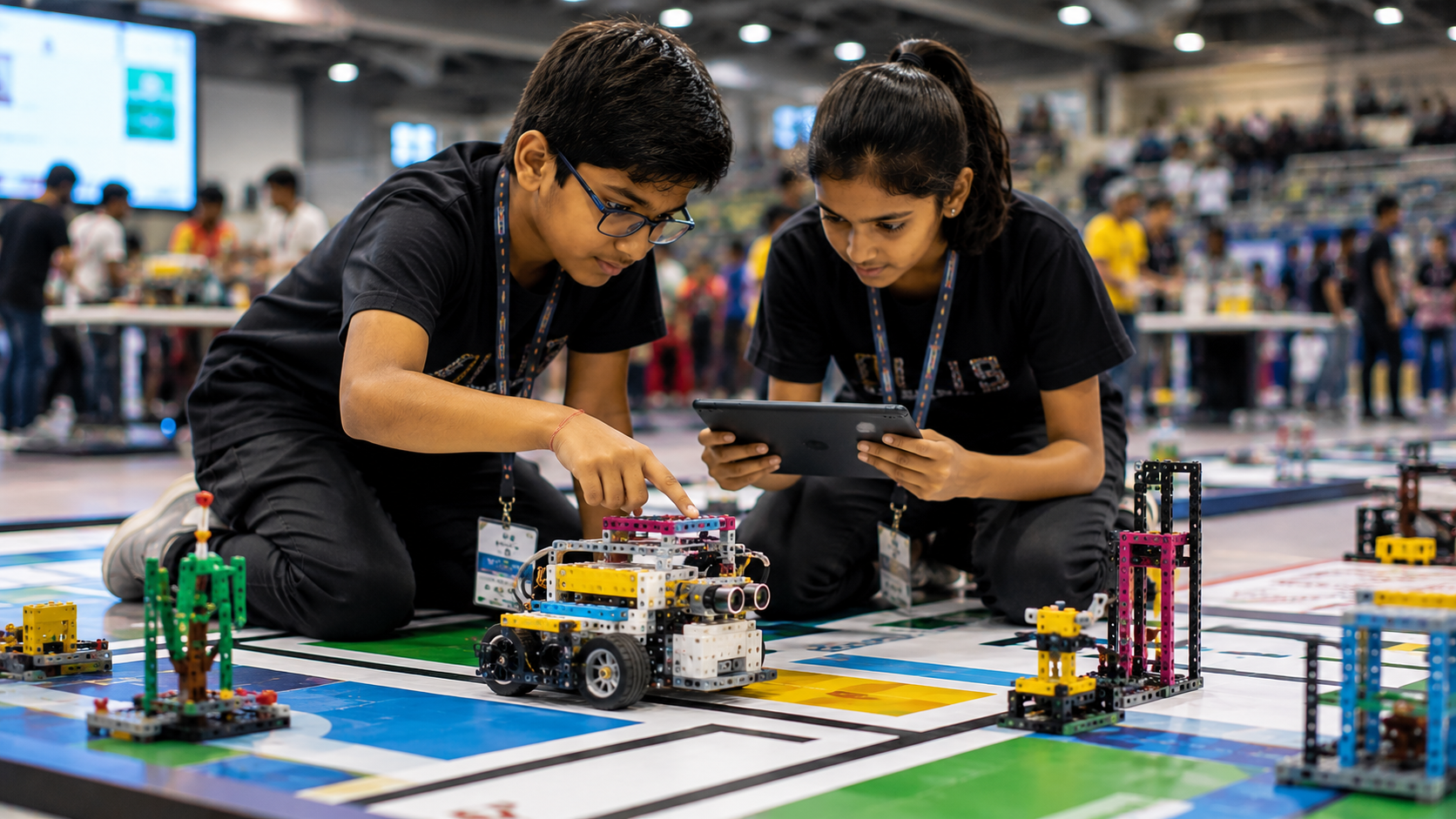
India sends 50+ teams to the World Robot Olympiad every year. That number is growing, and the 2026 season is already drawing serious interest from Mumbai families.
Knowing how to prepare for WRO 2026 is not about the most expensive kit. It is about building the right skills, in the right order, with enough lead time to make them stick.
Key Takeaways
- WRO 2026 runs three categories: Regular (RoboMission and RoboSports), Open, and Future Innovators, across three age groups
- India fields 50+ competing teams annually. Teams that reach nationals start preparing 6-12 months out
- Core skills: block coding to Python, LEGO Mindstorms or SPIKE Prime builds, and team coordination under pressure
- Structured coaching, not self-directed practice, builds competition-ready habits fast enough to matter
In This Article
- What Is the World Robot Olympiad?
- The 6-Month WRO 2026 Training Plan
- WRO 2026 India Registration
- How Technobotics Prepares Mumbai Kids
- Frequently Asked Questions
What Is the World Robot Olympiad and Why Does It Matter?
The World Robot Olympiad runs in more than 95 countries, with India fielding 50+ teams in recent seasons. National-round winners earn a place at the World Finals. Research confirms that competition-based STEM learning builds higher retention and stronger critical thinking than classroom-only instruction. For Indian students, WRO is one of the few competitions with a clearly structured national qualifier pathway.
For parents in Mumbai, this matters directly. Winning a state round earns your child a spot at the national finals. National finalists carry that credential into college admissions and early career opportunities.
WRO 2026 Categories and Age Groups
WRO 2026 runs three main categories, each testing a different mix of skills:
| Category | Sub-Category | Age Groups | Team Size |
| Regular | RoboMission | Elementary (8-12), Junior (11-15), Senior (14-19) | 2-3 students |
| Regular | RoboSports | Elementary (8-12), Junior (11-15), Senior (14-19) | 2-3 students |
| Open | Original Robot Design | Junior (11-15), Senior (14-19) | 2-3 students |
| Future Innovators | Innovation Project | Junior (11-15), Senior (14-19) | 2-3 students |
RoboMission is the most common entry point for first-time competitors. Teams build and program a robot to complete specific timed tasks on a playing field. The Open category rewards original design thinking over pure programming precision. Future Innovators challenges teams to present an innovation project to judges.
Your child’s age group determines which categories they qualify for. Students already enrolled in robotics classes for kids in Mumbai typically enter through RoboMission at the Elementary or Junior level.
The 6-Month WRO 2026 Training Plan That Works
Teams that reach WRO national finals start 6 to 12 months before competition day. Students with structured coaching consistently outperform self-directed peers on timed tasks. Starting early is the single biggest variable between a team that qualifies and one that does not.
Build Your 6-Month Preparation Timeline
A realistic WRO preparation plan follows this sequence:
- Months 1-2: Kit and foundations. Learn your robotics kit (LEGO SPIKE Prime or Mindstorms EV3). Practice basic builds, sensor placement, and motor control until the fundamentals are automatic.
- Months 3-4: Programming progression. Start with block coding in LEGO’s own environment, then begin the shift toward Python. Cleaner, faster code directly affects mission score.
- Month 5: Theme and mission study. WRO 2026 official mission rules are released on the WRO India portal each season. Check wroindia.org before finalising your robot build strategy. Points are often lost on misread rules, not failed builds.
- Month 6: Mock competition. Run full timed rounds. Record failure points. Fix mechanical weak spots. Practise handoffs and communication between team members under real time pressure.
The Three Skills WRO Judges Actually Measure
WRO performance comes down to three areas. Technical skill is only one of them.
- Programming precision. Teams with efficient, well-structured code complete more mission points in less time. Block coding is the starting point. Python is the competitive edge. Students who begin this progression early through hands-on Arduino and coding projects for school kids carry a measurable advantage into the competition floor.
- Mechanical reliability. A robot that misreads a sensor during a timed run loses points the team cannot recover. Stable, tested builds require iteration, not guesswork and last-minute fixes.
- Team coordination. WRO runs teams of 2 to 3 students. One manages the robot build, another handles the code. They must communicate clearly under time pressure. This skill does not develop on its own.
Most families focus almost entirely on the robot. The teams that reach finals also train as a unit.
What Do Parents Need to Know About WRO 2026 India Registration?
WRO India registration is team-based, not individual. Your child cannot register alone. Teams of 2 to 3 students must register through the official WRO India portal or an authorised regional organiser, with a certified coach attached to the registration. Schools affiliated with WRO India typically manage this centrally. Students at non-affiliated schools must register through a certified external training centre.
WRO 2026 India Registration: Parent Checklist
- Form a team of 2-3 students in the correct age group for your chosen category
- Choose your category: Regular (RoboMission or RoboSports), Open, or Future Innovators
- Confirm your coach or mentor meets WRO India certification requirements
- Register through the official WRO India portal or an authorised regional organiser
- Check WRO India for state-level qualifier dates and entry deadlines well in advance
If your child’s school does not have WRO affiliation, they can register through a certified robotics training centre. Students enrolled in structured robotics and STEM education for young minds at Technobotics get WRO team registration support as part of the competition prep program.
How Does Technobotics Prepare Mumbai Kids for WRO?
Technobotics has trained more than 10,000 students across Mumbai over 15 years, working with 13+ partner schools. NEP 2020 mandates experiential, project-based learning as a core pillar of education. Every Technobotics class builds that into the structure, from beginner sessions to advanced WRO competition prep tracks.
Students who reach WRO national rounds share a consistent pattern: structured training at least six months out, weekly practice without gaps, and at least one internal mock event before the state qualifier. None were particularly gifted at the start. Each was consistent.
The WRO competition program covers:
- LEGO SPIKE Prime and Mindstorms EV3 technical training
- Block coding to Python programming progression
- Mission strategy sessions built around current WRO themes
- Timed mock competition rounds with real scoring
- Team dynamics coaching alongside technical skill development
Most parents treat WRO preparation as a technology problem. It is also a team problem. Teams lose points not because the robot fails, but because two students miscommunicate during a 2-minute mission run and lose 30 seconds to indecision. Training the team together, not just the individual child, is what changes outcomes. Students in WRO competition training classes in Mumbai practise this team coordination as a structured part of every session.
Not every child who trains here enters WRO. Many apply the same skills to school science fairs or inter-school events. The foundation transfers across any competitive setting. Learn more about robotics training in Mumbai.
7 Frequently Asked Questions About WRO 2026
Q1. What age should my child start preparing for WRO 2026?
The Elementary category accepts students aged 8 to 12, making entry possible from around Grade 3. The Junior division runs from age 11 to 15. Starting at 8 or 9 gives your child time to build solid foundations before moving into Junior-level competition, where challenges are more complex and competitors are far better prepared. With competition robotics, earlier is always better.
Q2. Does my child need prior robotics experience to enter WRO 2026?
No prior experience is required to begin training. But entering WRO 2026 with no preparation is not realistic. Most competitive teams have 6 to 12 months of structured coaching behind them. A child starting now has a clear path to the 2026 season, provided they commit to consistent weekly practice with a qualified coach who understands the WRO format and scoring system.
Q3. What robotics kit does WRO 2026 use?
WRO officially supports LEGO Education SPIKE Prime for Elementary and Junior categories. LEGO Mindstorms EV3 remains widely used, particularly at the Senior level. The exact kit requirements depend on which category your team enters. Always check the official WRO 2026 rules document for your specific category before purchasing any equipment. Kit requirements can change between seasons.
Q4. How many students are on a WRO team?
WRO requires 2 to 3 students per team. A single student cannot enter alone. Teams must register, compete, and present as a unit. Choosing the right teammates is one of the most underrated parts of WRO preparation. Team chemistry under pressure affects performance more than most parents expect during a timed, high-stakes competition round.
Q5. How does WRO 2026 India registration work?
Registration happens at state level through the official WRO India portal or an authorised regional organiser. Your team must have a certified coach or mentor attached to the registration before it is accepted. Schools registered with WRO India typically handle this centrally. Students at non-affiliated schools can register through a certified training centre like Technobotics in Mumbai.
Q6. What is the difference between RoboMission and the Open Category?
RoboMission gives all teams identical building constraints and the same task to complete. It rewards programming precision and mechanical execution. The Open Category requires teams to design an original robot to solve a defined real-world problem. Open rewards engineering creativity and independent thinking. Both categories run across the Junior and Senior age groups. First-time competitors almost always start with RoboMission.
Q7. How much does WRO preparation cost for a Mumbai family?
A LEGO SPIKE Prime kit retails between Rs. 25,000 and Rs. 35,000. Training fees vary by centre and program length. Students at Technobotics partner schools often have kit access included in program fees, which reduces individual family costs significantly. Families who start early through a school partnership consistently face lower out-of-pocket expenses than those setting up privately at the last minute.
Your child does not need to be a prodigy to compete in WRO 2026. They need the right skills, the right team, and enough time to prepare properly. The 6-month timeline is not arbitrary. It maps directly to what competition-ready teams actually do, and it reflects 15 years of observing what separates teams that qualify from teams that don’t.
Start now. Every week of structured preparation compounds. The teams reaching WRO nationals in 2026 began working months ago. The teams that will reach WRO 2027 are starting today. Students starting WRO preparation now are also building the foundational skills for WRO 2027 and beyond.
Start WRO 2026 Preparation Today
Technobotics has trained 10,000+ students across 13+ Mumbai schools over 15 years. Enrol your child in the WRO 2026 competition program before the intake closes.