Your child just spent two hours watching someone else play a video game. Not playing. Watching. And when you called them for dinner, they were annoyed at the interruption.
If that scene feels familiar, you are not alone. Most Mumbai parents know the feeling of watching their child disappear into a screen and wondering what, exactly, is being gained. The answer, more often than not, is nothing that lasts.
That is precisely the gap robotics classes for kids are built to close. When a child moves from consuming content to building something with their own hands, something fundamental shifts in how they think. They stop waiting for the next thing to appear on screen and start asking how things work. The confidence that comes from making a robot actually move, from wiring it themselves and writing the code themselves, is something no amount of screen time can replicate.
Technobotics has spent 15 years helping Mumbai kids make exactly this shift, working with 10,000+ students across 13+ school partnerships. Here is what that experience shows.
Why Screen Time Alone Is Not Enough for Kids Today
The World Health Organisation recommends no more than one hour of recreational screen time per day for young children, and guidelines for older children emphasise purpose and quality over raw quantity. Most kids in Mumbai’s urban schools far exceed this, often before they have opened a textbook. But the real problem isn’t the hours. It is what those hours actually produce.
Watching videos, playing mobile games, scrolling through short-form content: these are all consumption activities. The brain receives input but produces almost no output. Ask a child what they learned from three hours on YouTube, and you will get a shrug. Ask them what they built in a 90-minute robotics class, and they will talk for twenty minutes.
Over time, passive screen habits erode exactly the cognitive muscles children need most: patience with hard problems, tolerance for failure, and the ability to focus long enough to see something through. A child conditioned to expect constant stimulation will struggle the first time a project does not work immediately, because the screen never made them sit with discomfort.
STEM robotics education addresses this directly. When a child wires a circuit, and it doesn’t work, they cannot skip to the next video. They have to think about why. That process of troubleshooting a real physical problem builds habits of mind that passive screens simply cannot.
India’s National Education Policy 2020 explicitly calls for integrating coding and computational thinking from Grade 6 onward, recognising that India’s future workforce needs makers, not just users. Robotics programs give children a meaningful head start on exactly that.
How Robotics Classes for Kids Replace Passive Screen Time
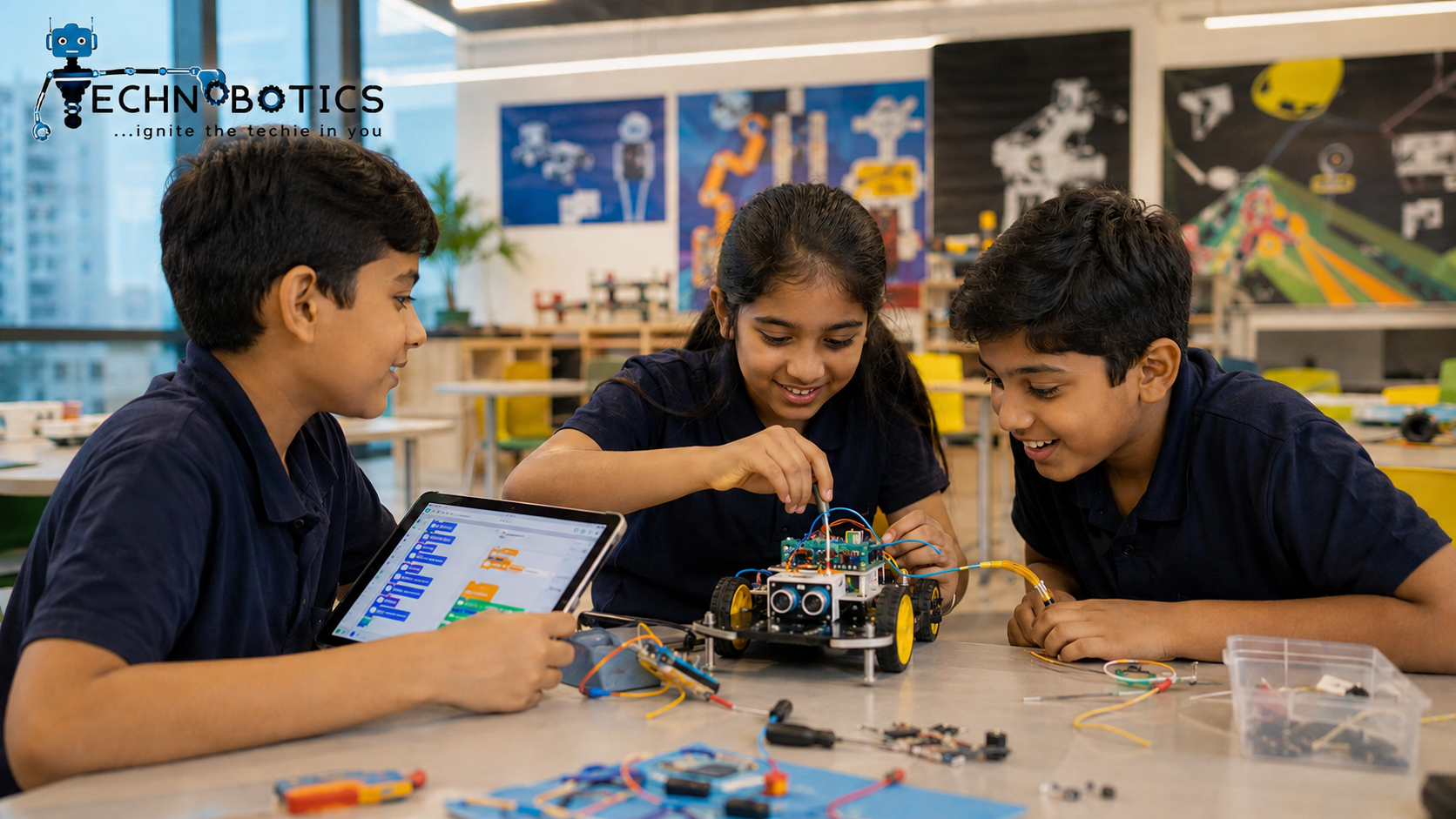
Robotics classes for kids replace passive screen time with a specific, hands-on problem to solve in every session. Instead of reacting to content created by someone else, children design, build, and test their own small machines. When a screen is involved at all, it is a tool for programming, not entertainment. The relationship with the device changes completely.
Here is something parents notice within a few weeks: unstructured device time starts losing its pull. Not because the child has been told to stop, but because building things is more satisfying than watching them be built. A child who has spent 90 minutes getting a motor to spin using code they wrote themselves is not rushing back to a tablet. They are thinking about what they want to build next.
This matters because habits form young and are hard to set. A child who spends ages 9 to 12 building circuits, writing code, and solving real problems develops a fundamentally different relationship with technology than one who spends those same years scrolling. One sees technology as a tool. The other sees it as entertainment.
Robotics courses for beginners at Technobotics are structured around this principle from day one. Every module ends with a working project that the child can hold, demonstrate, or take home. The completion loop, start something, solve the problems, finish it, is built into the curriculum at every level. That loop is what makes the habit stick.
Research from Johns Hopkins University’s education research programs confirms that students who engage in project-based STEM learning show stronger problem-solving transfer than peers in traditional instruction. Hands-on beats passive every time, and the effect compounds the earlier it starts.
What Children Actually Learn in Robotics Programs
Electronics and Circuit Fundamentals
Most children have never held a resistor before their first class. Technobotics begins here, with breadboard electronics and basic component identification. Children learn what voltage means, why a circuit needs to be complete, and what a short circuit actually looks like. This is not abstract theory from a textbook. They build a circuit, it doesn’t work, and they have to figure out why before the session ends. By the time they leave, they have fixed it themselves. That experience of diagnosing and solving a real physical problem in the same sitting is something most adults never had at that age.
Block Coding and Logic
Once a child understands how hardware behaves, software starts making sense in a way it never does on a computer screen alone. Block-based coding platforms let younger students grasp conditional logic, loops, and sequences without worrying about syntax errors. The goal is not memorising commands. It is understanding that a machine does exactly what you tell it, no more and no less, which teaches a precision of thinking that transfers directly into mathematics and science.
Arduino and Physical Computing
More advanced students move on to Arduino programming, where they write code to control physical components. The first time a student blinks an LED using code they typed themselves, the reaction is almost always the same: they want to do it again immediately, and make it do something more complicated. From there, the projects scale: motion sensors, automatic fans, line-following robots, and eventually small autonomous machines that respond to their environment.
Logical Thinking and Composure Under Pressure
These are the skills parents notice most, often before they notice the technical ones. A child who has debugged ten circuits does not panic when something fails on the first try. They have a process. They isolate variables. They stay calm and methodical. That composure shows up in maths exams, school science projects, and years later, in job interviews and professional problem-solving.
Real Benefits of Skill-Focused Robotics Learning
Screen time for kids often gets reduced to a simple good-or-bad argument. That framing misses the real question, which is whether the time produces anything lasting: a skill, a habit of mind, a finished project, a child can point to and say, “I made that.”
Robotics learning produces all three. Children who complete a beginner-to-intermediate curriculum consistently develop stronger spatial reasoning, better persistence on difficult tasks, and a working understanding of cause and effect in physical systems. Spatial reasoning alone is directly linked to secondary school performance in mathematics and engineering, subjects that increasingly determine which academic pathways remain open.
There is a social dimension that gets overlooked in most conversations about STEM education. Robotics classes are collaborative by design. Students work in pairs or small groups on shared problems. They have to explain their thinking to a teammate, negotiate when two solutions conflict, and accept that someone else’s idea might be better than their own. None of that happens in a solo screen session. These are skills that require other people to develop.
Coding and robotics classes in Mumbai at the Technobotics level are also genuinely progressive. Students do not repeat the same projects year after year. Each level introduces new components, new concepts, and new challenges. A child who starts at age 8 and stays engaged through age 13 will have covered electronics, block coding, Arduino programming, mechanical assembly, and introductory AI applications by the time they enter secondary school. That is a five-year foundation most engineering graduates never had.
How Technobotics Helps Kids in Mumbai Make the Switch
Technobotics has been running STEM education in Mumbai for 15 years. The curriculum has been built, tested, revised, and refined across more than 10,000 student journeys and 13+ school partnerships. What exists today is not a first draft. It is a program shaped by thousands of children getting stuck, getting unstuck, and going further than they thought they could.
Structured Levels, Not One-Size-All
The program runs from absolute beginner to advanced, and placement is based on assessment, not age or school grade. A ten-year-old with no prior exposure is not placed alongside students writing Arduino code. A nine-year-old who picks up electronics quickly is not held back with younger beginners. Children are always challenged at the right level, which means they are rarely bored and rarely lost.
Project-Based Assessment
There are no written tests at Technobotics. Progress is measured by what a student can build, explain, and demonstrate. At the end of each module, students present a working project to their batch. Parents receive a written project report showing what their child built, what problems they encountered and solved, and what level they have moved to. It is a far more informative picture than a test score.
Weekend and Weekday Batches
Flexibility matters for Mumbai families managing school timetables, tuition schedules, and extracurricular commitments. Technobotics offers both weekend and weekday batches designed to fit around academic demands rather than compete with them. Weekend spots fill fastest, particularly for beginner levels, so early enrolment makes a practical difference.
FAQs
Q1: At what age is it right to start robotics classes for kids?
Most children are ready at age 7 or 8, when they can follow multi-step instructions and work carefully with small components. Technobotics places students based on a readiness assessment rather than age alone. Some 6-year-olds are well prepared; some 10-year-olds benefit from starting at the beginner level, regardless of school grade. The assessment removes the guesswork and ensures your child starts where the learning will actually stick.
Q2: How is robotics different from just learning to code on a computer?
When a child codes on a screen, the result lives on the screen. When they code in a robotics class, the result moves, lights up, or follows a line on the floor. That physical feedback changes everything. Abstract logic concepts that feel slippery on a monitor become obvious when a motor does exactly what the code told it to do or fails because the code has a mistake. The tangibility is not incidental. It is why robotics builds understanding that screen-only coding often doesn’t.
Q3: How many hours per week does a child need to commit?
Most Technobotics batches run 1.5 to 2 hours per session, once or twice a week. That is enough time to complete a meaningful project stage without overloading a school-age child’s week. Most parents find that robotics time naturally replaces unproductive screen time rather than adding to an already full schedule. The child chooses it over the tablet because it is more engaging, not because they are told to.
Q4: My child has no background in electronics. Can they still join?
Yes, completely. The beginner curriculum is designed for students with no prior knowledge of electronics, coding, or other technical fields. The first sessions cover basic component identification and simple circuit assembly before any coding is introduced. Instructors are trained to meet students where they are, and class sizes are small enough that no child falls behind without someone noticing immediately.
Q5: Will robotics classes help my child in school exams?
Not directly. Technobotics does not teach in school syllabi or exam formats. But the indirect effect is consistent: after six to twelve months of robotics learning, children typically show stronger logical reasoning, better focus, and more confidence with maths and science problems. The thinking skills transfer even when the curriculum content doesn’t overlap. Several Technobotics students have credited the program with changing how they approach exam preparation altogether.
Q6: How is progress tracked without exams?
Progress is tracked through project completion and live demonstration. At the end of each module, students present a working build to their batch and explain how it works. Parents receive a written project report showing what their child built, what problems they encountered and solved, and what level they have moved to. It is a far more informative picture than a percentage score.
Q7: What makes Technobotics different from other robotics programs in Mumbai?
Fifteen years of operation, 10,000+ students, and 13+ active school partnerships represent a depth of curriculum refinement that newer providers simply cannot match. The Technobotics instructors have seen every way a child can get stuck and know how to help them through it without doing the work for them. Programs that are two or three years old are still learning what Technobotics refined over its first five years.
Conclusion
Every hour a child spends building something real is an hour spent developing skills that carry forward. Robotics classes for kids do not compete with school. They strengthen the thinking that school demands. They turn time that was producing nothing into time that produces logical thinkers, confident problem-solvers, and children who, at an age when it matters most, understand that technology is something you control, not something that controls you.
Technobotics has been helping Mumbai families make this shift for 15 years. The children who started young are now engineers, developers, and people who approach hard problems without flinching. Your child can start building that foundation today.