Most children understand technology as something they use. Robotics teaches them how to build it. STEM Robotics Education bridges that gap by combining science, technology, engineering, and mathematics into hands-on projects that kids actually finish, test, and fix themselves. At Technobotics in Mumbai, more than 10,000 students have gone through this process over 15 years. For parents, the next step is clear: sharper problem-solving, stronger logical thinking, and genuine confidence in working with technology from an early age.
Why Robotics Works So Well for STEM Learning
STEM education is built on applied learning. A child does not truly grasp electrical circuits by reading about them. They grasp it when a wire is placed incorrectly and keeps the LED from turning on, and they have to figure out why. Robotics creates exactly that kind of learning loop: build, test, fail, fix, repeat.
According to Wikipedia’s overview of STEM education, the core goal of STEM frameworks worldwide is to develop students who can solve real problems using cross-disciplinary thinking. Robotics delivers this especially well because it requires all four disciplines working together at once.
Coding and Logic Come Alive Through Robots
A robot does exactly what you tell it to do. That precision is one of the most effective teaching tools available. When a student writes a command, and the robot moves in the wrong direction, they learn to trace their logic step by step until they find the error. This is computational thinking in its most concrete form.
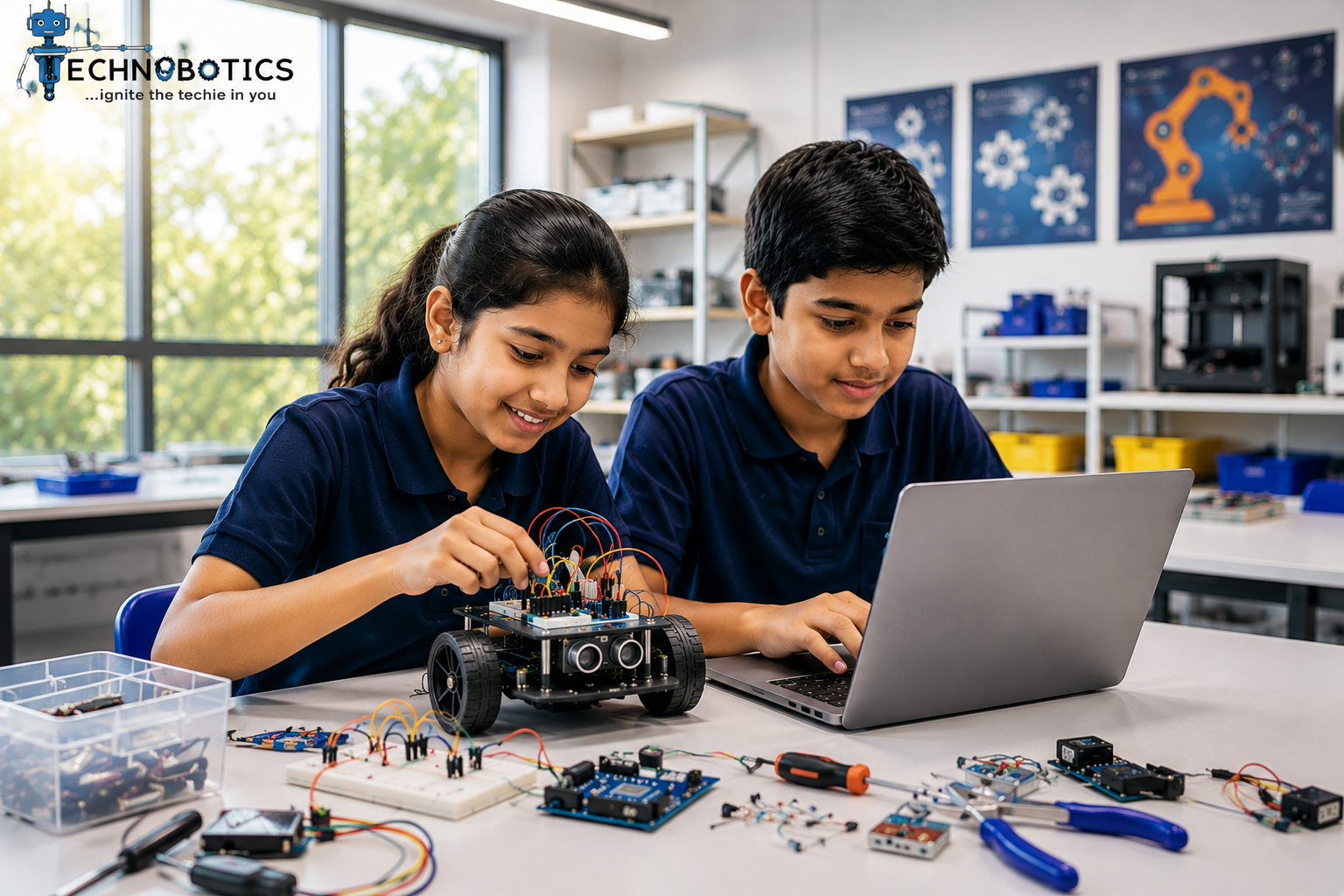
Through Arduino programming, students at Technobotics learn to write real code that controls physical hardware. They see inputs, outputs, and conditions not as abstract concepts but as causes and effects they can observe in real time. That connection between code and consequence accelerates understanding in a way that screen-only programming cannot replicate.
Circuits, Electronics, and Physical Problem-Solving
Robotics for students also means working with physical components. Wires, sensors, resistors, and microcontrollers are all part of the build process. Students who work through breadboard electronics develop an intuition for how circuits behave that stays with them long after the class is over.
Research published on ScienceDirect confirms that hands-on STEM activities produce measurably higher engagement and retention compared to lecture-based instruction. That is why robotics stands out as one of the clearest examples of that finding in practice.
How Robotics Courses for Kids Build Real Skills
The skills that matter most in robotics are not just technical ones. Patience, persistence, collaboration, and the ability to break a big problem into smaller pieces are all traits that robotics training develops naturally. For parents, this means a child who has spent an afternoon debugging a sensor circuit has practised more focused analytical thinking than most classroom exercises deliver in a week.
Robotics courses at Technobotics in Mumbai are structured to guide students through increasing levels of complexity. Beginners start with simple circuits and basic programming concepts. Intermediate students build functional robots and introduce sensors and actuators. Advanced learners take on autonomous systems, competition-level builds, and more sophisticated coding challenges.
Confidence Is a Core Outcome
One outcome that parents consistently notice is confidence. A child who builds something that works, fixes it when it breaks, and then builds something harder develops a very specific kind of self-belief. For parents, this shows that children learn that problems have solutions and that they can find them with the right tools and enough persistence.
Researchers studying robotics for kids have linked participation in structured robotics programs to improved academic performance in mathematics and science. The reasoning skills transfer. The belief in one’s own ability to work through difficulty transfers, too.
Teamwork and Communication
Most robotics projects at Technobotics involve teams. One student handles the build, another focuses on the code, and a third manages testing. They have to communicate clearly for the robot to work. This mirrors how engineering teams operate in real-world professional environments, making robotics one of the best early introductions to collaborative technical work.
Bringing Robotics Into Schools: A Smarter Approach
School-based robotics programs have grown significantly across India in recent years. The National Education Policy 2020 explicitly emphasises experiential learning and STEM integration from early grades. Schools that have adopted structured robotics curricula are seeing stronger student interest in science and technology subjects at the secondary level.
Technobotics currently partners with more than 13 schools across Mumbai to deliver robotics as part of the academic calendar. These are not one-off workshops. They are ongoing programs woven into the school timetable, with curriculum aligned to the age and academic level of each cohort. To explore how this works, visit the school robotics curriculum page.
The advantage of school integration over standalone after-school programs is consistency. Students engage with robotics weekly rather than occasionally. That regular practice is what builds durable skills rather than just passing familiarity.
India’s National Education Policy 2020 sets clear targets for hands-on, activity-based learning across all levels of schooling. Robotics programs aligned to those targets are not just valuable for students; they are increasingly expected by schools that take their STEM mandate seriously.
Why Parents in Mumbai Choose Technobotics
STEM education in Mumbai has expanded rapidly over the last decade. There are more options for parents today than there were five years ago. What makes Technobotics the choice for so many families is the combination of depth and track record. Fifteen years of operation, 10,000 students taught, and 13 partner schools show consistent delivery over time and give parents a clear reason to trust the program.
Parents often tell the Technobotics team that their children come home from class wanting to show what they built. If you want that kind of intrinsic motivation, it is a sign that a program has genuinely connected with how children learn. For parents, it also makes progress easier to see and share at home.
The best robotics classes in Mumbai are not simply the ones with the most equipment. They are the ones where instructors know how to pace the difficulty, encourage persistence through failure, and make the learning feel like discovery rather than instruction. For parents, Technobotics stands out because it has spent 15 years refining exactly that approach.
What to Expect From Robotics Classes at Technobotics
A first session at Technobotics is deliberately approachable. No prior experience is required. Students are introduced to basic components, shown how they interact, and given a simple project to complete. For parents, the goal of the first session is not to produce a complex robot. The goal is to make the student feel capable and curious.
From there, each level builds on the last. STEM education at Technobotics follows a structured progression that ensures no student is overwhelmed and no student is held back by a pace that is too slow for them. For parents, instructors assess each student’s progress and adjust accordingly.
Programs Available
Technobotics offers programs across several tracks, from foundational electronics and coding to advanced robotics and competition preparation. There are options for individual enrollment as well as school group programs. The curriculum is updated regularly to reflect current tools and technologies.
Classes are available for students ages 7 and up, with separate tracks for different age groups and experience levels. Parents who are unsure which level is right for their child can request a placement consultation before enrolling, making it easier to choose the right starting point.
What is STEM Robotics Education? STEM Robotics Education is a hands-on learning approach that combines science, technology, engineering, and mathematics through building and programming robots. Students work with real components, write functional code, and solve design problems. This method develops technical skills alongside critical thinking, teamwork, and persistence in a structured, progressive curriculum.
FAQs
Q1: What is STEM Robotics Education?
STEM Robotics Education is a hands-on learning approach that combines science, technology, engineering, and mathematics through building and programming robots. Students work with real components, write functional code, and solve design problems. It develops technical skills alongside critical thinking, teamwork, and persistence in a structured, progressive curriculum.
Q2: At what age can a child start robotics classes?
At Technobotics, students can begin as young as age 7. Programs are structured by age group and experience level, so younger children start with foundational electronics and simple building tasks. Older students with prior experience move into more complex coding and autonomous robot design. If you are considering the beginner track, there is no upper age limit.
Q3: Do children need prior knowledge of coding to join?
No prior knowledge is required. Technobotics classes start from the very basics: how components work, what circuits do, and how to write simple commands. Students build their understanding step by step. Prior experience with coding or electronics is helpful but not a requirement for any entry-level class.
Q4: How is robotics different from a regular computer science class?
A standard computer science class focuses on writing and understanding code on a screen. Robotics adds a physical dimension: the code controls a machine. Students see the immediate result of every command they write. That feedback loop makes abstract concepts concrete and develops both technical and analytical skills more effectively than screen-only environments.
Q5: Is Technobotics suitable for school group programs?
Yes. Technobotics currently runs active programs in more than 13 schools across Mumbai. These are structured as part of the school timetable, not one-time events. Schools receive defined learning outcomes, trained instructors, and curriculum aligned to their students’ academic levels.
Q6: What makes Technobotics different from other robotics centres in Mumbai?
Technobotics has 15 years of operating experience and has trained more than 10,000 students. The curriculum is built around progressive skill development rather than one-off projects. Instructors are trained not just in robotics but in how to teach it effectively to different age groups. That combination of depth and track record sets it apart.
Q7: Can robotics training help with academic performance in school?
Research supports a strong link between hands-on STEM participation and improvement in mathematics and science performance. The reasoning and problem-solving habits built through robotics transfer directly to academic work. Students consistently demonstrate stronger logical thinking and a higher tolerance for working through complex, multi-step problems.
Conclusion
STEM Robotics Education is one of the most effective ways to prepare children for a world shaped by technology. It does not just teach them to use tools. It teaches them to build, debug, and improve them. At Technobotics, that preparation happens through structured, progressive programs backed by 15 years of experience and trusted by thousands of families and schools across Mumbai. Whether a child is just starting out or ready for advanced builds, there is a clear path forward here.
Give your child the skills to build real technology, not just use it.